Changelly verification: KYC triggers, identity checks and held swaps
Updated ·
Changelly verification becomes necessary when risk screening places a crypto swap on hold for compliance review. KYC means Know Your Customer; AML means anti-money laundering. Not every crypto swap requires document checks, although an affected transaction can pause while compliance reviews the requested information. The request may involve a government-issued photo ID, a selfie or liveness check and evidence of how you acquired the crypto. Fiat purchases follow the selected payment provider's verification rules. Before committing funds, consider whether you can supply those records and wait for a compliance decision. Completing an identity check does not by itself confirm release of a held exchange.
The short version: A swap can remain on hold after identity approval while compliance reviews its funding history or requests further evidence.
Open the account verification entry or use a compliance-issued link
A held swap normally has a verification entry in the registered account or instructions from Changelly's compliance team. Registered users can open the affected transaction in history and use its identity check. An exchange initiated through a partner or by an unregistered app user may instead require a link from the security team. Both options must relate to the exchange that needs review.
If that link has expired, request a replacement for the existing case. In the web flow, the "Verification complete" screen confirms completion of the on-screen checks; an expired-link message only confirms that the link is no longer usable. Use the account entry when you have access to it, or the compliance-issued link when that route applies. Confirm completion in your verification flow before waiting for the compliance team's decision on the held exchange.
- If the held transaction appears in your account, open its verification entry.
- If a partner initiated the exchange, obtain the compliance instructions for that exchange.
- If the verification link has expired, request a fresh link before uploading documents.
- If the requested evidence is unavailable, ask compliance what other records it can consider.
- Before treating the hold as resolved, read the compliance response for any remaining requirements.
Identity approval and transaction review answer different questions
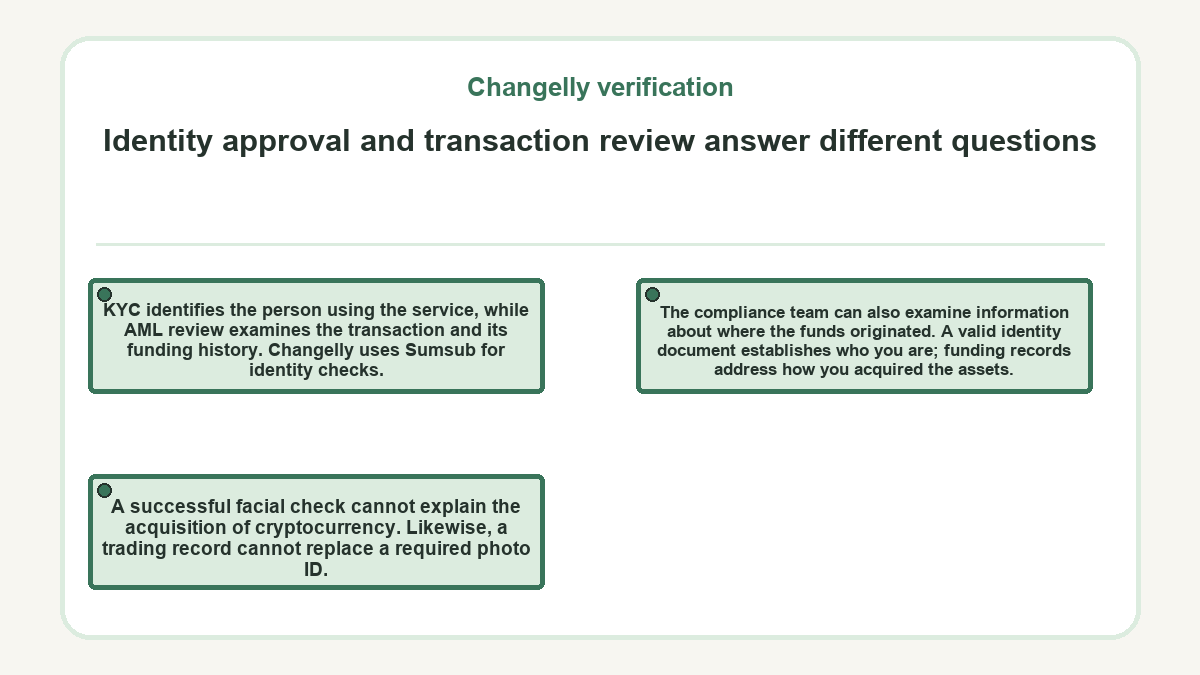
KYC identifies the person using the service, while AML review examines the transaction and its funding history. Changelly uses Sumsub for identity checks. The compliance team can also examine information about where the funds originated. A valid identity document establishes who you are; funding records address how you acquired the assets. A successful facial check cannot explain the acquisition of cryptocurrency. Likewise, a trading record cannot replace a required photo ID.
Risk screening determines who must supply documents
Changelly can apply AML/KYC procedures to particular users, addresses and crypto transactions. Its risk controls can flag attempts to mislead verification and transactions involving addresses that raise compliance concerns. A review request does not establish wrongdoing. It means the service requires more information before it can proceed with the affected exchange.
An earlier successful swap does not exempt a later transaction from review. Do not select a smaller amount on the assumption that it prevents KYC.
A fixed-rate quote concerns pricing conditions and still leaves the exchange subject to compliance checks. Choosing a floating rate also provides no exemption.
Use an accepted ID with clear, unaltered photographs
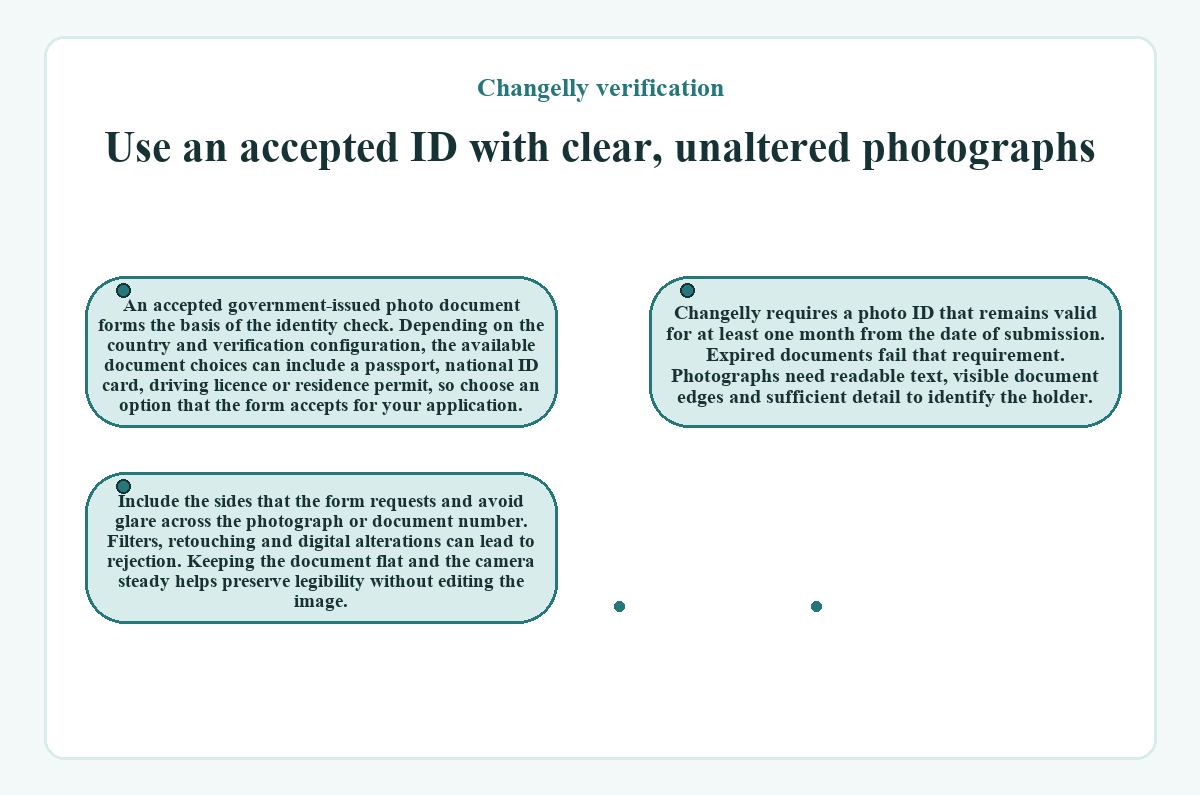
An accepted government-issued photo document forms the basis of the identity check. Depending on the country and verification configuration, the available document choices can include a passport, national ID card, driving licence or residence permit, so choose an option that the form accepts for your application. Changelly requires a photo ID that remains valid for at least one month from the date of submission. Expired documents fail that requirement.
Photographs need readable text, visible document edges and sufficient detail to identify the holder. Include the sides that the form requests and avoid glare across the photograph or document number. Filters, retouching and digital alterations can lead to rejection. Keeping the document flat and the camera steady helps preserve legibility without editing the image.
Explain the origin of the funds under review
A source-of-funds request asks how you obtained the cryptocurrency involved in the exchange. It can accompany identity verification or follow it when compliance needs further information.
Records that can support the explanation include receipts from a crypto seller, an exchange's transaction history and a bank statement showing the purchase. The record needs to address the actual origin of the funds, with the relevant personal details and transaction dates.
Direct purchases from another person can require an agreement or other records of that transaction. Mining activity can also have its own supporting records.
A blockchain transaction hash identifies an on-chain transfer. By itself, it does not explain a purchase agreement or show how a person paid for the assets. Provide the acquisition records that the request needs, keeping them distinct from evidence of the later transfer into the exchange.
Where records are missing, describe that gap to compliance and ask which alternatives it can assess. Acceptance depends on whether the evidence satisfies the review.
Review time follows the outstanding compliance work
An identity check and the investigation of a held transaction can run on different timelines. The usual identity-review estimate is within 24 hours, with longer review possible for security reasons. A wider investigation can sometimes take weeks or months when other parties participate. That estimate for an ordinary ID check does not set a deadline for releasing a held exchange. The identity form may acknowledge completed verification while the security team still has work to do. Its email response communicates any further requirements.
Keep the exchange record available when asking about an unresolved case, so the team can confirm whether identity approval is complete, whether source-of-funds evidence remains outstanding and whether the transaction still has a compliance hold. A document upload alone establishes submission, not release of the crypto.
Correct the specific cause of a document rejection
Unreadable images, altered documents and a mismatch between the face and ID can prevent acceptance. The correction must address the reason given for that application. A clearer photograph helps with blur or glare, while an unsupported document type requires another accepted document. Geographic restrictions raise a separate eligibility issue that retaking photographs cannot fix. The compliance team can explain whether another submission is possible; repeated uploads of the same rejected material do not resolve the underlying issue.
Partner-wallet holds and fiat checks have different owners
A wallet's built-in exchange can send an order through Changelly's partner integration. That entry point does not remove Changelly's AML/KYC policy from the swap. When an integrated exchange receives a hold status, the partner must give the user instructions, and Changelly's security team handles the required compliance steps. Keep the partner's order reference and the Changelly exchange identifier distinct when discussing the case.
Buying or selling crypto for government-issued currency can involve a payment provider with its own verification requirements. Some purchase providers offer limited transactions without full KYC under their own conditions. Those conditions do not establish an exemption for Changelly crypto-to-crypto swaps. Payment-provider verification, purchase eligibility and a bank's handling of a payment remain separate from an instant exchange's compliance review.
A refund request needs a case-specific response
A compliance hold does not itself establish refund eligibility or authorize cancellation. Ask the team handling the exchange whether completion or a refund is available and which requirements remain outstanding. For refunds involving misuse of the service, Changelly's terms allow operating-cost and network-fee deductions with prior user consent. A request for a refund is different from approval of one, and neither confirms that a return transfer has occurred. Do not apply an ordinary failed-swap refund estimate to an unresolved AML investigation.
Identity documents create a continuing privacy commitment
Verification connects personal information with a crypto exchange and may include facial images and records of financial activity. Changelly processes identity data through its verification service and can share information where its service arrangements or legal obligations require disclosure. Before uploading a funding record, consider what unrelated financial information it discloses. Ask what the review needs before withholding fields that may be necessary to assess the document.
Changelly's AML/KYC policy sets a five-year retention period for identification information after account closure. Identity-verification records have a separate five-year retention period from creation. A deletion request therefore does not ensure immediate removal of every compliance record. When submitting sensitive material, use the verification flow or compliance instructions attached to the case, since a request for identity documents can expose financial records as well as the personal information on an ID. Keep identity documents out of public support posts, and never include a wallet's private key or recovery phrase in an identity submission.
Consider advance verification before committing funds
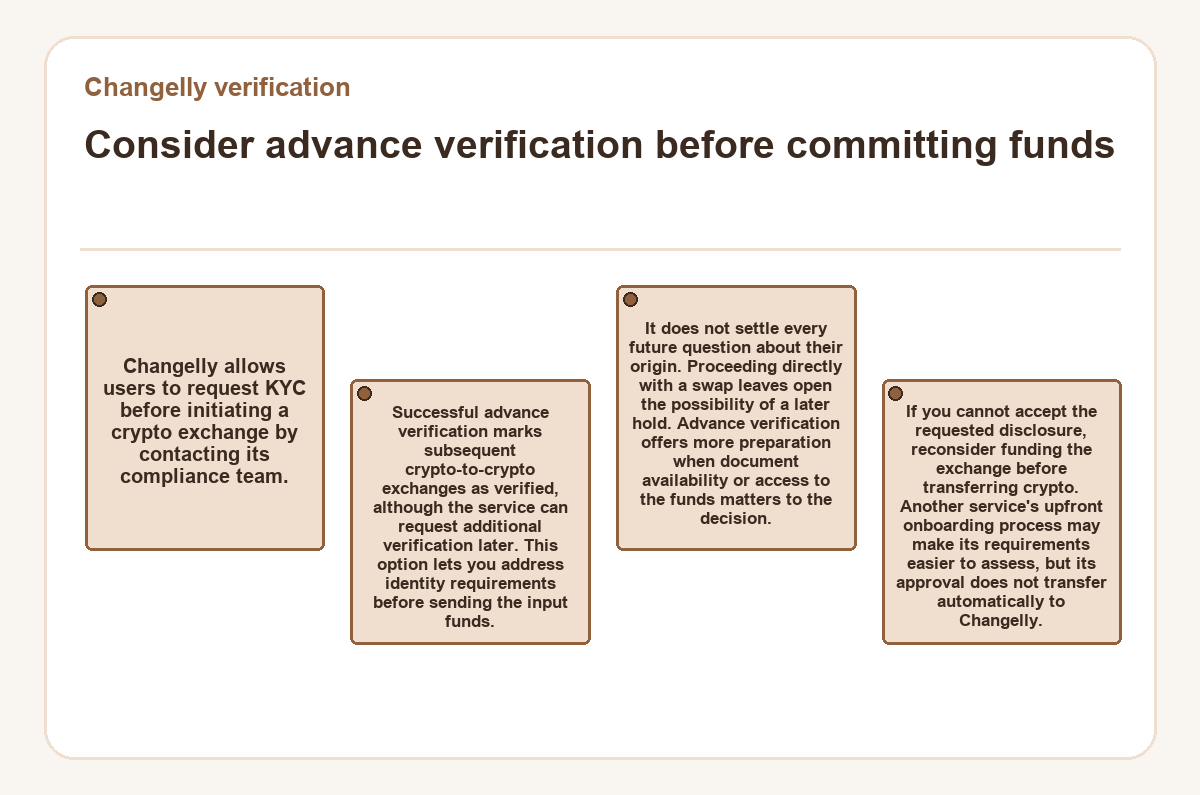
Changelly allows users to request KYC before initiating a crypto exchange by contacting its compliance team. Successful advance verification marks subsequent crypto-to-crypto exchanges as verified, although the service can request additional verification later. This option lets you address identity requirements before sending the input funds. It does not settle every future question about their origin.
Proceeding directly with a swap leaves open the possibility of a later hold. Advance verification offers more preparation when document availability or access to the funds matters to the decision. If you cannot accept the requested disclosure, reconsider funding the exchange before transferring crypto. Another service's upfront onboarding process may make its requirements easier to assess, but its approval does not transfer automatically to Changelly.
Changelly verification - common questions
Does verifying my email complete Changelly KYC?
Email verification confirms account registration and does not complete identity verification. The website uses an email link, while app registration can use an emailed code. A separate KYC request can require an accepted identity document and facial checks. Completing registration therefore does not establish approval of the documents or clearance of a particular exchange.
Can a digital identity document replace a physical ID for Changelly verification?
A digital ID is usable only if the Changelly verification flow accepts it for the relevant document and country. Sumsub supports some digital documents, but the company requesting verification controls its own acceptance conditions. If your document is absent from the form's options, ask compliance which alternative it accepts rather than choosing an inaccurate document category.
How can I finish Changelly liveness verification with a broken computer camera?
A supported phone continuation can provide the camera needed for the live check. The verification flow can offer a phone link or QR code. Camera access must work in both the browser and device settings, and another application must not occupy the camera. A saved selfie cannot substitute for a requested live capture.
When does Changelly verification require a notarized English translation?
A notarized English translation may be necessary when the verification service cannot process the language of your identity document. Submit the original document alongside the translation, which needs the translator's details and the notary's authentication. Non-Latin text alone does not establish that a translation is necessary; the language support for the verification determines that requirement.
Will KYC completed at another exchange satisfy a Changelly request?
Verification at another exchange does not automatically satisfy Changelly's request. Changelly can rely on another institution's identity checks under specific arrangements, including a qualifying agreement covering the identification requirements. Possessing a verified account elsewhere does not establish that such an arrangement applies. The outstanding Changelly request still determines which information you must provide.
Where should I report incorrect personal details in a Changelly verification application?
Report incorrect or outdated identity details to Changelly's compliance team so it can specify the required correction. Its AML/KYC rules require customer information to remain true, complete and up to date. Explain the discrepancy and identify the affected exchange if a hold is involved. Do not edit an identity-document photograph to match an incorrect form entry.